The teachings presented in this publication were given in Tibetan by Kyabje Tenga Rinpoche in August of 1986 at the Kamalashila Institute in Germany. In a clear, accessible way, Rinpoche elucidated the instructions included in the commentary A Chest of Amrita by Jamgön Kongtrul Lodrö Thaye.
I was fortunate to attend these teachings in person. Listening first in Tibetan, and then through English and German interpretation, I was able to take extensive and detailed notes.
Nearly twenty years later, a group of German practitioners affiliated with the Benchen Phuntsok Ling Centre in Allmuthen transcribed these teachings into German, preserving them for internal use within Rinpoche’s students’ circle. I wish to express my deep gratitude to them; without their efforts, the present English version would likely never have come into being.
While in a long retreat practising White Tara sadhana, Lama Martina prepared a working English translation from the German for her own personal use. I subsequently revised and refined this English text, drawing on my original notes as well as on numerous explanations I received from Tenga Rinpoche over the years, both during public teachings and while translating Rinpoche’s responses to private questions of students engaged in this yidam practice. For this reason, it would not be accurate to describe the present work simply as a translation of the German text, though it has certainly served as an important source of inspiration.
It is my sincere hope that this collective effort will prove beneficial to many practitioners. I have strived to present here as faithful a record of Tenga Rinpoche’s teachings as possible. Any errors or shortcomings are entirely my own.
The drawings illustrating various elements of the visualisation were painted by Tenga Rinpoche himself, in white on blue card. They were often used by Rinpoche to explain this practice.
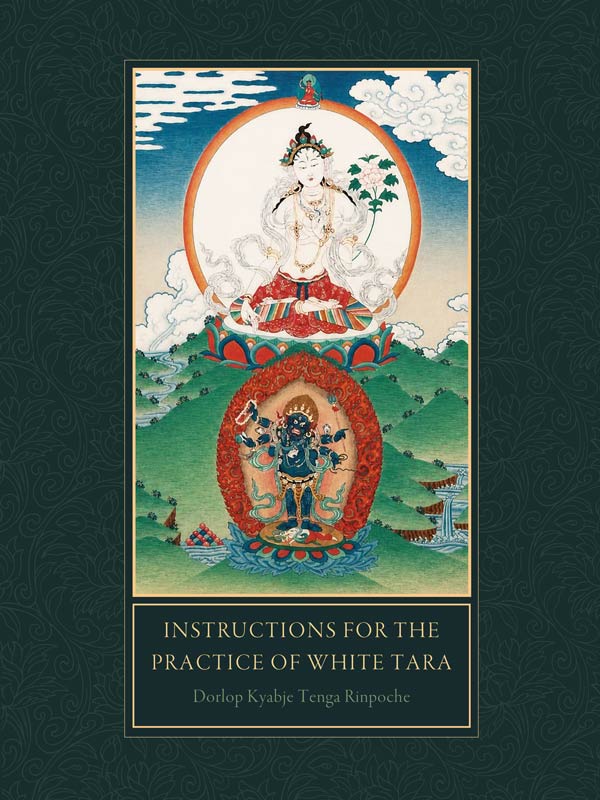
In addition, the thanka used on the book cover was painted by Rinpoche and it represents three main practices of the Tenga lineage. The First Tenga Rinpoche, Lama Samten, was devoted to Karma Pakshi, pictured above White Tara. The Second Tenga Rinpoche, Chogyal Tenzin Drupchok, as advised by his root guru Jamgön Kongtrul Lodrö Thaye, was mainly practicing Six-Armed Mahakala (Tib. Chadrukpa). And White Tara was the main yidam of the Third Tenga Rinpoche, Tenzin Trinle.
The photographs of the three-dimensional palace (Tib. lo lang བློ་བླངས་) of the White Tara mandala were taken by myself in Pharping, Nepal, inside the stupa containing Tenga Rinpoche’s relics. This palace was constructed precisely according to Rinpoche’s instructions. Some of its features differ from the style in which such mandalas are commonly created in many other monasteries.
The final editorial revision of the English text was carried out by Ani Tsekyi Buchanan from KTD Monastery. We are extremely grateful to her for all the help she provided.
Lama Rinchen
Benchen Karma Kamtsang Centre, Grabnik, Poland
April 2026